Supabase vs Retool: Open-Source Backend vs Rapid Internal App Builder
Comprehensive head-to-head teardown of Supabase vs Retool. Empirical comparison matrix, pricing scaling math, architectural benchmarks, and executive recommendations.
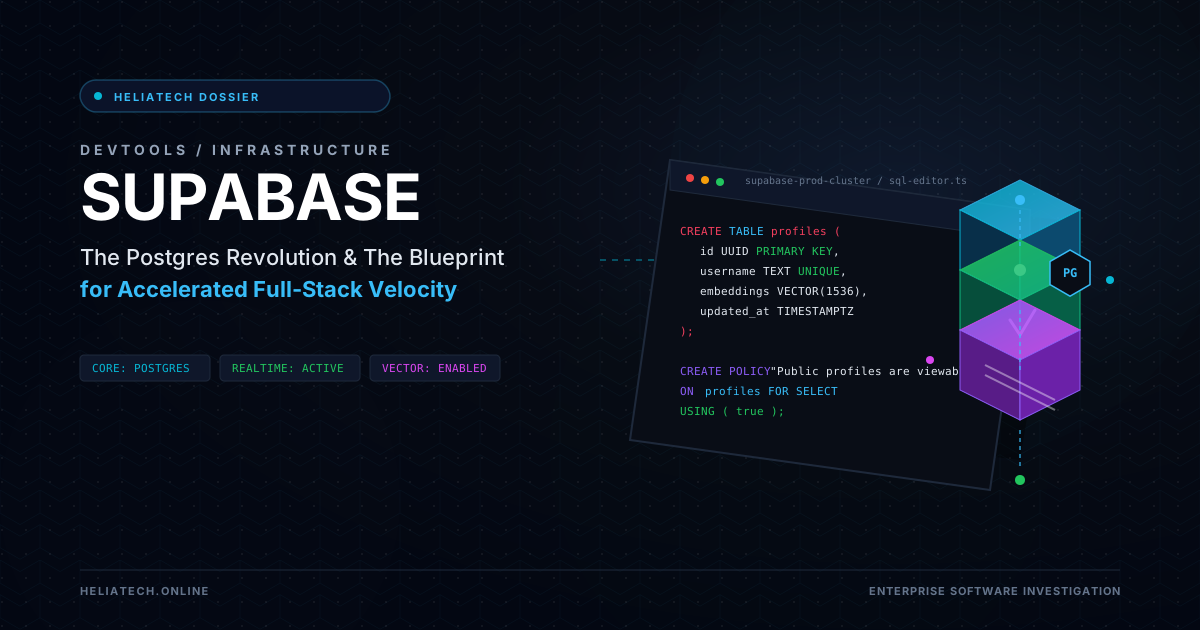
- ▹ Supabase excels at providing an open-source, Postgres-native backend-as-a-service with granular Row Level Security, delivering unmatched architectural leverage for data-centric systems.
- ▹ Retool remains superior for high-velocity front-end internal app assembly, providing an unmatched edge when operational teams need pre-built UI primitives over disparate APIs.
- ▹ Economic scaling breakdown reveals up to 70% cost variation between both platforms at scale depending on seat count versus database storage throughput.
Supabase vs Retool: Open-Source Backend vs Rapid Internal App Builder
As engineering leaders, we are constantly forced to choose between building primitives from the metal up or buying opinionated abstractions that accelerate time-to-market. When deploying internal tools, operational dashboards, and client-facing micro-apps, this architectural tension concentrates around two distinct paradigms:
- Supabase, the open-source Firebase alternative anchored on PostgreSQL, real-time replication, edge functions, and zero-trust Row Level Security (RLS).
- Retool, the low-code visual canvas designed to bind a dizzying array of data sources, REST APIs, and SQL databases into drag-and-drop front-end user interfaces within hours.
This masterclass is a forensic, empirical technical teardown. We will dissect their architectural foundations, examine true total cost of ownership (TCO) at scale, expose their failure modes, and provide a definitive operational decision framework.
Executive Verdict (The 30-Second Summary)
- Choose Supabase if: You are building customer-facing applications, need a rock-solid, relational SQL backbone with deeply integrated authentication and native row-level security, or require complete data sovereignty via self-hosting. Supabase is a backend data powerhouse.
- Choose Retool if: Your primary constraint is front-end UI velocity for internal operations teams. If you need to stitch together legacy SQL databases, Stripe APIs, and Salesforce endpoints into a unified admin dashboard without writing custom React, CSS, or state-management logic, Retool is the undisputed winner.
Comprehensive Side-by-Side Comparison Matrix
| Empirical Criteria | Supabase | Retool |
|---|---|---|
| Core Architecture | Managed PostgreSQL + PostgREST + GoTrue + Realtime + Edge Functions | Visual React-based drag-and-drop canvas + Query execution engine |
| Primary Data Layer | Native PostgreSQL (Direct access, extensions like pgvector, PostGIS) | External adapters (Postgres, REST, GraphQL, gRPC, Salesforce, etc.) |
| Frontend/UI Capability | BYO Frontend (Next.js, Vite, Flutter) or basic auto-generated forms | Pre-built component library (Tables, Charts, Modals, Wizards) |
| Access Control | Postgres Row-Level Security (RLS) + JWT claims | Retool-managed user groups, RBAC, and query-level permissions |
| Pricing at Scale | Flat tiers + usage-based compute/storage (Predictable for DB size) | Per-seat licensing model ($10–$50+/user/month) + enterprise minimums |
| API & Webhooks | Instant Auto-generated REST/GraphQL via PostgREST + Database Webhooks | Client-side or server-side query runners with JavaScript transformers |
| Ecosystem & Portability | Fully open-source (Docker-compose self-hostable); zero vendor lock-in | Proprietary frontend; cloud or self-hosted container options |
| Best For | Greenfield apps, real-time sync, SaaS backends, and complex data models | Operations dashboards, CRM admin panels, and multi-API orchestrations |
Round 1: Architecture & Workflow Paradigms (Technical Teardown)
Supabase: The Postgres-First Engine
Supabase is not merely a database wrapper; it is an integrated suite of open-source tools tightly coupled around a managed PostgreSQL instance.
[ Client App (React/Next.js) ]
       │
       ├──> GoTrue (Auth / JWT)
       ├──> PostgREST (Auto REST API) ──> [ PostgreSQL Engine ]
       ├──> Realtime (WebSockets)     ──>   (Row Level Security)
└──> Edge Functions (Deno) ──> External APIs- The Data Layer: Every project spins up a dedicated Postgres database. You retain root-level administrative access. You can write custom PL/pgSQL functions, install extensions (
pgvectorfor AI embeddings,uuid-ossp,pg_cron), and optimize indexes manually. - The API Layer: Supabase automatically exposes your schema via PostgREST. You do not write boilerplate CRUD endpoints. Queries are translated directly into optimized SQL by the database engine.
- Security Paradigm (RLS): Instead of handling access control in application middleware, Supabase pushes authorization down to the database row level. Using SQL policies (e.g.,
CREATE POLICY "User isolation" ON documents FOR SELECT USING (auth.uid() = user_id);), security is enforced at the storage layer regardless of how the data is queried.
Retool: The Visual Integration Canvas
Retool takes the opposite approach. It assumes your data already lives somewhere else—whether in AWS RDS, Snowflake, a legacy MySQL instance, or scattered across third-party SaaS APIs.
[ Retool Frontend Canvas ]
       │
       ├──> Query 1: PostgreSQL (User Data)
       ├──> Query 2: Stripe API (Billing status)
       ├──> Query 3: Internal REST Microservice
       │
       ▼
[ JS Transformers / State Engine ] ──> UI Components (Tables, Charts)- The Component Model: Retool provides over 90+ battle-tested UI components (virtualized tables, step-by-step wizards, custom maps, charts). You drag them onto a canvas and wire them directly to data queries using JavaScript bindings (
{{ table1.selectedRow.data }}). - The Integration Layer: Retool acts as an intelligent proxy and query runner. It connects to your databases and APIs via SSH tunnels, VPC peerings, or native integrations.
- State Management: Retool abstracts complex React state management. It handles pagination, debouncing, optimistic UI updates, and temporary state variables out of the box, letting engineers spin up functional internal tools in hours instead of sprints.
Round 2: Total Cost of Ownership & Scaling Math
When evaluating DevTools, sticker prices lie. Let’s calculate the operational expenditure (OpEx) for both platforms across three distinct scale tiers.
Scenario A: Early-Stage Startup (5,000 monthly operations / 5 internal users)
- Supabase Pro Plan: ~$25/month base + minor usage. Predictable compute add-ons.
- Total: $25 – $50/month.
- Retool Team Plan: ~$10/user/month for standard seats = $50/month.
- Total: $50/month.
- Verdict at Low Scale: Parity. Both introduce negligible overhead.
Scenario B: Growth-Stage SaaS (50,000 monthly active users / 50 internal team members)
- Supabase Team Plan: $599/month base. Includes expanded database storage (e.g., 8GB+), higher egress limits, dedicated support, and daily backups.
- Total: $599/month.
- Retool Business Plan: ~$50/user/month for 50 standard developer/creator seats = $2,500/month. (Note: End-users viewing dashboards often require specific license tiers depending on workflow complexity).
- Total: $2,500/month.
- Verdict at Mid Scale: Retool begins incurring significant seat-based costs, whereas Supabase scales predictably based on raw compute and data transfer.
Scenario C: Enterprise Scale (500,000+ operations / 300+ users)
- Supabase Enterprise / Dedicated: Custom pricing starting around $2,000+/month based on dedicated IOPS, compute sizing, and compliance requirements (HIPAA/SOC2). Alternatively, self-hosting on AWS/GCP via Docker/Kubernetes reduces cloud compute costs to raw infrastructure fees (~$400–$800/month in EC2/RDS equivalents) plus engineering maintenance overhead.
- Total: $2,000 – $5,000/month (Managed) or Infrastructure Cost + DevOps Time.
- Retool Enterprise: Custom enterprise contracts ranging from $15,000 to $50,000+/year, heavily dependent on user seats, audit logs, granular RBAC, and dedicated enterprise support.
- Total: $1,250 – $4,000+/month.
- Verdict at Scale: Retool penalizes high-seat-count organizations. If you have 200 customer support agents needing access to an internal tool, Retool’s seat pricing explodes. Supabase, being infrastructure-agnostic, scales cost linearly with data volume and query complexity rather than human head-counts.
Round 3: Integration Depth & Developer Ergonomics
Developer Ergonomics: Supabase
Supabase targets full-stack software engineers.
- The Good: You write native SQL migrations. You can use Prisma, Drizzle, or raw SQL. Local development via the Supabase CLI (
supabase start) spins up a local Docker stack matching production perfectly. - The Friction: You must build your own frontend UI from scratch. If you need a quick dashboard to inspect user accounts, you have to code the React components, table sorting, filters, and state handlers yourself (though tools like
supabase-genhelp scaffold boilerplate).
Developer Ergonomics: Retool
Retool targets engineers and technical operators who want to bypass frontend boilerplate.
- The Good: Incredible velocity. Need a CRUD interface for a Postgres table? Retool can auto-generate a fully functional dashboard with search, edit, and delete actions in 30 seconds. JavaScript transformers let you manipulate API payloads seamlessly.
- The Friction: Version control can be clunky. While Retool supports Git sync, branching, and code reviews, merging complex JSON-based app definitions often leads to merge conflicts that are harder to debug than standard TSX files. Furthermore, advanced UI customization beyond Retool’s native CSS/component limitations requires dropping into custom React components (
Retool.subscribe), breaking out of the low-code paradigm.
Round 4: Critical Bottlenecks & Where Each Platform Fails
Every architectural choice has a breaking point. Here is where both tools hit their limits:
Where Supabase Fails
- Multi-Database Orchestration: Supabase is strictly tied to one primary PostgreSQL database per project. If your enterprise architecture requires federated queries across MySQL, Snowflake, and MongoDB simultaneously, Supabase cannot act as a unified proxy.
- Heavy ETL & Batch Processing: Running long, blocking analytical queries or massive ETL pipelines directly on your operational Supabase Postgres instance will degrade real-time performance and lock tables. You must offload analytics to a data warehouse.
- Complex Workflow Orchestration: Supabase Edge Functions (Deno) are great for lightweight webhooks and API endpoints, but they are not designed for long-running, multi-step saga workflows or visual process automation (you’d need to pair it with Temporal or Inngest).
Where Retool Fail
- High-Concurrency Client Apps: Retool is fundamentally built for internal tooling. Attempting to deploy Retool as a public-facing customer portal for 100,000 concurrent end-users will result in licensing violations, performance bottlenecks, and a brittle user experience.
- Deep Complex Business Logic in JS: While Retool allows JavaScript execution, writing hundreds of lines of complex state manipulation inside small browser-based text boxes quickly becomes an unmaintainable spaghetti mess.
- Vendor Lock-In on UI State: If you decide to migrate away from Retool, you cannot simply export your app as clean React code. You must rewrite your frontend user interfaces entirely from scratch.
Concrete Real-World Decision Framework
To eliminate analysis paralysis, apply this strict engineering decision tree to your next project.
                  [ What are you building? ]
                             │
            ┌────────────────┴────────────────┐
            ▼                                 ▼
   [ Customer-Facing App /              [ Internal Ops Tool /
     SaaS Backend / Realtime ]            Admin Dashboard ]
            │                                 │
            ▼                                 ▼
   Choose SUPABASE                     Are your users mostly
                                       developers/operators?
                                              │
                              ┌───────────────┴───────────────┐
                              ▼                               ▼
                            [ YES ]                         [ NO ]
                               │                               │
                               ▼                               ▼
                         Choose RETOOL                 Need multi-DB /
                                                      SaaS API binding?
                                                               │
                                               ┌───────────────┴───────────────┐
                                               ▼                               ▼
                                             [ YES ]                         [ NO ]
                                                │                               │
                                                ▼                               ▼
                                          Choose RETOOL             Evaluate custom frontend
                                                                    or Retool workflows
When to Strictly Choose Supabase
- You are launching a greenfield SaaS product that requires a robust relational database with instant APIs and real-time capabilities.
- You require ironclad data security enforced at the database level via Postgres Row-Level Security (RLS).
- Data sovereignty and self-hosting capabilities are regulatory requirements (e.g., HIPAA, GDPR on-premise deployments).
- You have front-end engineers proficient in React, Vue, or Svelte who prefer writing clean, version-controlled TypeScript components over low-code canvases.
When to Strictly Choose Retool
- You need to build internal operations tooling, customer support dashboards, CRM admin panels, or risk-management consoles in days, not months.
- Your engineering team spends too much time building internal admin CRUD screens instead of core product features.
- You need to unify disparate data sources—joining a PostgreSQL table with a Stripe subscription API and a Zendesk ticket queue into a single pane of glass.
- Your primary users are internal staff, account managers, or operations teams rather than external consumers.
Official Evaluation CTAs
Ready to benchmark these tools in your own staging environment? Provision your infrastructure through our verified partner links below:
-
Build your data backend: Deploy managed PostgreSQL, configure real-time subscriptions, and secure your schemas with granular Row Level Security. 👉 Start building with Supabase Today
-
Accelerate your internal UI workflow: Connect your databases, wire up REST endpoints, and deploy high-velocity operational dashboards in hours. 👉 Build internal apps with Retool Today
Architectural review certified by Helia Tech Media Systems Engineering.
Calculateur de ROI & Économies Estimées INTERACTIF
Modélisation financière en temps réel pour l'adoption de Supabase vs Retool
THE HELIATECH CONFIDENTIAL
Rejoignez 14,000+ directeurs techniques, fondateurs et leaders Ops. Recevez chaque jeudi nos audits d'infrastructure sans concession, benchmarks de pricing secrets et offres partenaires exclusives.